
Grid-Compliant Solid-State Transformers for Stable and Flexible Hybrid AC/DC Networks

New Grid Structures Require Active and Grid-Compliant Power Electronics

As the share of converter-based generation and loads increases, rotating masses and available short-circuit power are decreasing in many grids. As a result, maintaining voltage and frequency stability is becoming increasingly challenging, particularly in weak grids.

Conventional 50 Hz transformers provide voltage conversion but cannot offer active control functions or a direct DC interface. Solid-state transformers extend this functionality through power electronic control. For operation at the medium-voltage level, however, these systems must meet the relevant grid connection requirements.

Additional challenges arise in hybrid AC/DC grids. On the DC side, aspects such as voltage levels, grounding, protection concepts, and DC fault management are not yet uniformly standardized in all areas. At the same time, the control system must safely manage different operating conditions, including grid-connected and islanded operation as well as black start.

For manufacturers and operators, early validation is therefore essential. Grid requirements, control strategies, and system behavior should be considered together during development, before extensive testing and certification processes begin.
Consider Grid Requirements from the Start and Validate Medium-Voltage Converters Systematically

Fraunhofer ISIT develops and evaluates medium-voltage power electronic systems for hybrid AC/DC grids. The focus is on solid-state transformer and modular multilevel converter concepts as well as their control and system integration.

Grid requirements are taken into account early in the development process. ISIT develops grid-forming control methods as well as functions for fault ride-through, reactive power provision, frequency support, harmonic compensation, black start, and transition to islanded operation.

Another focus is the direct integration of battery storage into modular converter structures. ISIT investigates the interaction between converter operation, state-of-charge management, and battery aging. This allows grid requirements and battery system requirements to be considered together.

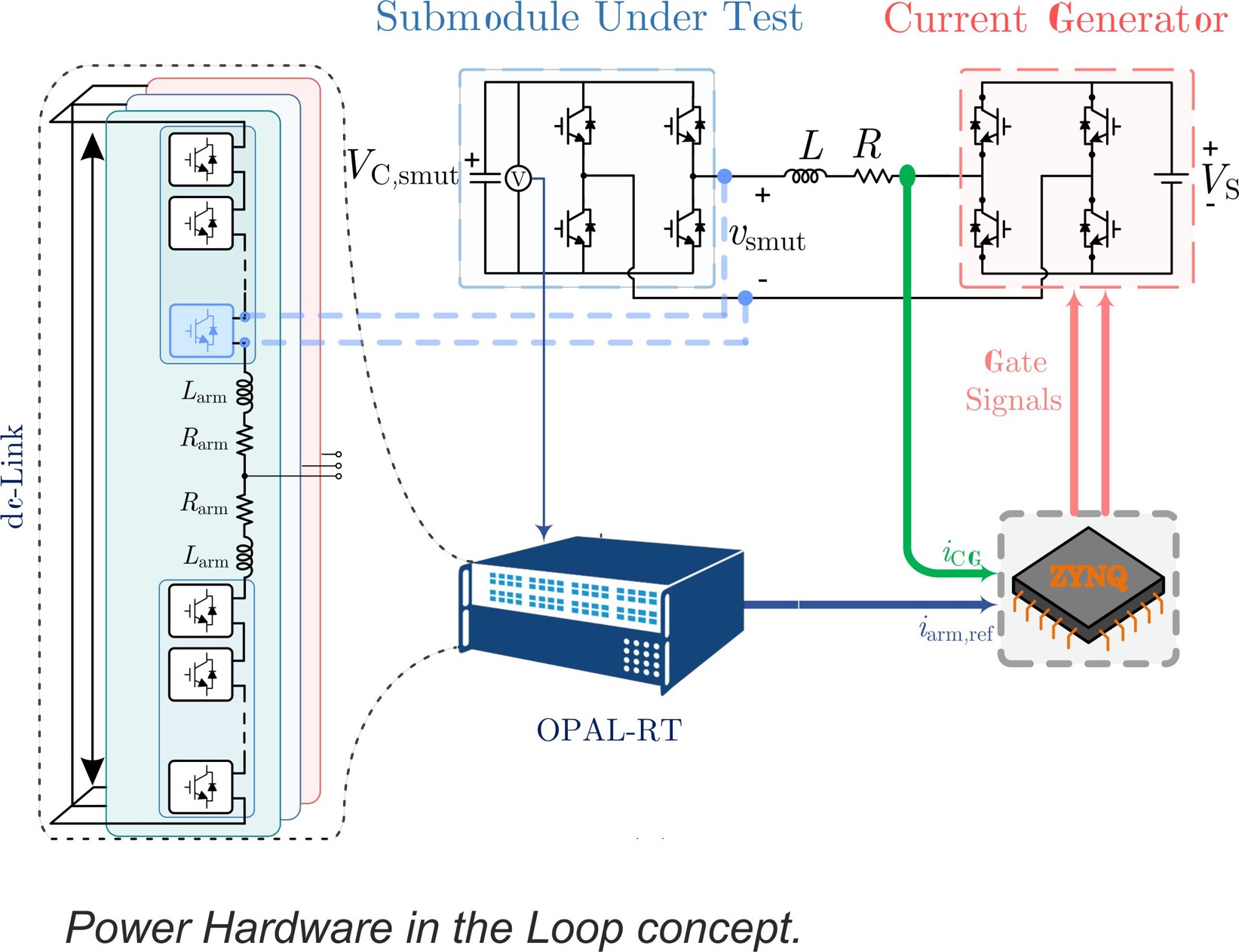
For validation, ISIT combines simulations with controller hardware-in-the-loop (CHIL) and power hardware-in-the-loop (PHIL). This enables control functions and system behavior to be evaluated before extensive medium-voltage testing.


Assess the Grid Compliance of Your Medium-Voltage System at an Early Stage


Modular Multilevel Converters Combine Medium Voltage, Battery Storage, and Active Grid Control

Modular multilevel converters (MMCs) are a key technology. They consist of modular converter cells and enable scalable power electronics for medium-voltage applications. ISIT focuses in particular on MMC architectures with directly integrated battery submodules.

Integrating the battery at the submodule level eliminates the need for a central battery interface with separate DC/DC conversion. At the same time, individual submodules can be controlled separately and their states of charge can be balanced.

In addition to MMC technologies, ISIT investigates solid-state transformer stages based on bidirectional dual-active-bridge converters (DABs) with medium-frequency transformers and medium-voltage power stages based on silicon carbide (SiC).

Control is implemented in real time on FPGA and DSP platforms. Methods include cascaded voltage and current control, model predictive control, and grid-forming approaches such as the virtual synchronous machine. Control methods for balancing energy and state of charge among individual converter modules are also used.

From Simulation to Hardware Testing

For development and validation, ISIT combines several levels:

  • Electromagnetic transient and multidomain simulation
  • MATLAB/Simulink, PLECS, and PSCAD
  • Real-time control on FPGA and DSP platforms
  • Controller hardware-in-the-loop (CHIL)
  • Power hardware-in-the-loop (PHIL)
  • Battery characterization and aging tests
  • Thermal investigations
  • Electromagnetic compatibility
  • Insulation coordination for medium-voltage systems

ISIT combines expertise in batteries, medium-voltage power electronics, and grid integration. Battery testing and characterization laboratories, medium-voltage test infrastructure, and real-time simulation and hardware-in-the-loop systems are also available.

End-to-End Testing from Simulation to Demonstrator Reduces Development Risks

Model → CHIL → PHIL → Demonstrator

Grid-forming functions and system behavior are evaluated step by step, from simulation to hardware testing.

Flexible Power Electronics for Energy Systems, Industry, and Charging Infrastructure

Solid-state transformers and modular medium-voltage converters are relevant for applications that require AC and DC systems to be interconnected, battery storage to be integrated, or active grid functions to be provided. They form a technological basis for flexible energy infrastructures in which different generation systems, storage systems, and loads are interconnected.

The approach is particularly relevant for systems that need to transmit high power while actively responding to grid requirements. The direct DC interface enables DC components to be integrated without requiring separate interfaces for each application.

At ISIT, a multilevel converter with integrated battery modules is being developed at laboratory scale, while a reusable hardware-in-the-loop test environment is used to evaluate grid compliance. This allows different operating and application scenarios to be investigated and control functions to be validated under defined conditions.

The technology also offers potential for additional applications, including railway power supply, offshore platforms, MVDC collector grids, and the retrofit of existing medium-voltage substations with actively controllable systems.


Evaluate Potential Applications for Your Grid or Energy Storage System


Ensure Grid Compliance During the Development Process

Simulation, controller hardware-in-the-loop (CHIL), and power hardware-in-the-loop (PHIL) help identify critical control and system issues at an early stage. Necessary adjustments can therefore be made before extensive medium-voltage and certification testing.

End-to-End Validation Reduces Development Risks

ISIT combines modeling, CHIL, PHIL, and demonstrators into an end-to-end validation chain. Control functions and system behavior can be evaluated step by step under realistic conditions and prepared for subsequent testing.

Combine Multiple Energy and Grid Functions in a Single System

Solid-state transformers can combine voltage conversion, AC/DC coupling, battery storage, and active grid functions within a single architecture. A direct DC interface also enables the integration of storage systems, generation systems, and DC loads

Modular Converters Enable Fault-Tolerant Operation

Integrating battery storage at the submodule level creates a modular system architecture. Individual submodules can be controlled independently, and their states of charge can be specifically balanced. The redundancy of the architecture supports fault-tolerant operation.

Optimize the Battery and Converter Together for System Operation

ISIT considers converter control and the battery system together. Current loads, state of charge, thermal behavior, and battery aging can therefore be taken into account during system development and coordinated with grid operation requirements.

Grid-Forming Functions Enable Additional Applications

Grid-forming control methods enable functions such as frequency and voltage support, islanded operation, and black start. This makes the systems relevant for applications requiring active grid support or operation in weak grids.