High-Efficiency Multiport DC/DC Converters

Increasing DC Power Demand Requires More Efficient and Compact Converter Architectures

As the power demand of data centers, battery storage systems, hydrogen systems, and charging infrastructure increases, so does the number of different DC voltage levels. Systems may need to connect DC buses at 400 V, 800 V, or 1500 V with power supplies operating at 48 V.

Conventional architectures use multiple separate DC/DC converters for this purpose. Each additional converter requires its own power electronics and magnetic components. Additional conversion stages also create further sources of power loss.

Particularly at megawatt power levels, efficiency has a major impact on power losses and cooling requirements. At the same time, high system availability is essential: the failure of a single converter should not cause the entire system to fail. However, conventional N+1 redundancy increases the amount of hardware required.

Multiport architectures address these challenges by coupling multiple interfaces within a common converter architecture.

Comparison of two three-phase-based DC/DC converters with a DC/DC converter based on a multiwinding transformer (MTB)

Multiport Converters Combine Multiple DC Interfaces in a Common Architecture

Fraunhofer ISIT develops modular multiport DC/DC converters that couple multiple DC interfaces through a common multiwinding planar transformer. Instead of using several separate converters, a shared architecture enables energy exchange between different sources, storage systems, and loads.

Development covers both hardware and control. ISIT evaluates suitable topologies, develops integrated magnetic components, and designs control strategies for power flow between the individual ports. Soft switching and fault-tolerant operating strategies are incorporated into system development from the outset.

From initial design to experimental validation, ISIT combines simulation, hardware development, and testing. Prototypes are characterized in terms of efficiency and thermal behavior and can be evaluated using power hardware-in-the-loop (PHIL) and realistic load profiles.

ISIT also develops approaches for integrated condition monitoring, digital twins, and reliability-oriented control.


Develop a Multiport Converter for Your Application


Modular multiport DC-DC converter

Integrated Magnetics Connect Multiple DC Ports with Fewer Conversion Stages

The core technology connects multiple DC interfaces through a multiwinding transformer. Multiple windings are combined within a single magnetic component, allowing energy to be exchanged between the ports within a common converter architecture.

ISIT develops multiwinding planar transformers using printed circuit board technology. Leakage inductance and cooling are also taken into account during the design process. Liquid cooling integrated into the windings provides additional options for compact thermal management concepts.

The power electronic stages use technologies including silicon carbide MOSFETs (SiC MOSFETs) and gallium nitride high-electron-mobility transistors (GaN HEMTs). Topologies under investigation include multiple-active-bridge and dual-active-bridge architectures as well as bidirectionally reconfigurable topologies.

Multiphysics Optimization Combines Electrical, Magnetic, and Thermal Requirements

Converter and magnetic component development uses coupled electrical, magnetic, and thermal simulations. Pareto optimization supports the evaluation of different design variants based on multiple objectives.

The development approach ranges from low-power stages and kilowatt-scale systems to the investigation of scalable architectures for higher power levels.

Digital Twins Provide Insight into Operating Loads During Operation

Digital twins and integrated condition monitoring make it possible to evaluate operating conditions and loads within the power electronics. Methods include temperature-sensitive electrical parameters and fiber-optic measurement techniques.

The resulting condition data provides a basis for active thermal control and reliability-oriented operating strategies.

Infrastructure for Development and Validation

  • Medium-voltage laboratory up to 10 kV AC, 1 MW, and 1600 A
  • Auxiliary converters up to 500 kW
  • RTDS, OPAL-RT, and Typhoon HIL PHIL test benches
  • Climate chambers from −40 to 180 °C and 10 to 98% relative humidity
  • Packaging and failure analysis at ISIT
  • Wire bonding and silver sintering
  • X-ray imaging, computed tomography, and acoustic microscopy

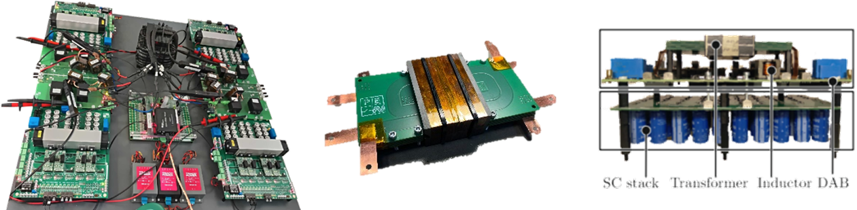
Prototype of a multiport power converter for microgrid applications: 4-port converter (left), 4-winding 50 kHz planar transformer (center), and supercapacitor stack and interface converter (right)

Multiport Converters Connect Energy Sources, Storage Systems, and Loads on a Common Platform

Multiport DC/DC converters are relevant for systems in which multiple DC voltage levels, energy sources, or storage systems need to be connected simultaneously. One focus is on power supply architectures for data centers and other high-power DC systems.

In data centers, for example, 800 V DC links and 48 V IT power supplies can be connected with battery backup systems and supercapacitors within a common architecture.

Battery storage and fuel cell systems can also be coupled to different DC buses through multiple ports. Additional applications include isolated DC/DC stages for solid-state transformers as well as high-power charging and hydrogen infrastructure.

For renewable energy systems, bidirectional converters are relevant for photovoltaic and battery storage systems with 1500 V DC architectures.

ISIT already has various development platforms and demonstrators available for investigating these concepts. These include a four-port converter, a supercapacitor interface, an isolated DC/DC stage for solid-state transformers, and low- and medium-voltage MMC platforms.


Evaluate a Multiport Architecture for Your Application


Fewer Conversion Stages Reduce Losses Along the Power Path

Multiple ports exchange energy within a common converter architecture. Compared with architectures using several separate DC/DC converters, this can reduce the number of conversion stages and components. Soft switching further supports low-loss operation.

Integrated Planar Magnetics Increase Power Density

Multiwinding planar transformers combine multiple windings within a single magnetic core. Integrated cooling designs enable a compact thermal layout and support high power densities.

An efficiency of over 99.6 percent was measured for the magnetic circuit. In addition, a power density of 12 kW/l, a 70 percent reduction in temperature difference, and an increase in power density of more than 230 percent were achieved.

Power Routing Increases Availability Through Targeted Redundancy

The modular architecture enables targeted control of power flows between different ports and modules. Faults can therefore be taken into account when controlling the overall system. The concept aims to provide fault-tolerant operation with minimal additional redundancy.

Reliability-Oriented Control Considers Service Life During Operation

Status information can be fed directly into the converter's control system. Digital twins, temperature data, and other monitoring parameters enable the operating mode to be specifically adapted to the load on individual components.

Reliability-oriented control extends the B10 service life by 8 percent.

An End-to-End Development Process Reduces Design Risk

The development process combines Pareto optimization, prototype development, PHIL testing, and load-profile testing. Concepts can therefore be evaluated step by step, from simulation to realistic operating conditions. This supports early assessment before integration into the target system.

Fewer Individual Components Simplify System Architecture

A common multiport architecture can reduce the number of separate converters and magnetic components. This offers the potential to reduce component count and cooling requirements compared with architectures using multiple standalone DC/DC converters.