
Talkative Power Conversion: Communication via the Energy Path

Transmit More Condition Data Without Unnecessarily Expanding the System Architecture

Power converters, power modules, battery cells, sensors, actuators, and electric drives increasingly need to exchange operating and condition data. This information provides a basis for monitoring, control, and diagnostics, among other functions.

Communication often requires additional cables, connectors, interfaces, or wireless modules. Especially over short distances within a power converter, power module, or battery system, these additional components increase integration complexity. They require additional space and create additional potential points of failure.

Manufacturers and system integrators therefore need ways to make more information available within power electronic systems without having to add separate communication paths.
Use the Existing Power Path for Data Transmission

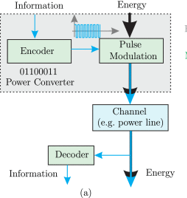
Fraunhofer ISIT develops communication methods that use existing power electronic functions to transmit information. Instead of requiring a separate communication module, the switching operations already performed by the power converter serve as carriers for additional information.

For this purpose, individual characteristics of the switching pulses are modified slightly and in a controlled manner. Information can be encoded, for example, through switching frequency, phase position or pulse position, or duty cycle. Power conversion remains the primary function of the converter.

This approach enables the concept to be investigated and tested across different power electronic architectures.


Explore the Potential of Integrated Communication


Modulate Switching Operations to Transmit Information

Talkative Power Conversion combines power and data transmission over the same power path. The concept is based on the high-speed switching operations that power converters use to convert and control electrical energy.

For communication, specific switching characteristics are intentionally modulated. A power converter can operate as both a transmitter and a receiver. Communication functions are integrated directly into the converter control. Information is encoded on the transmitter side and transferred through the power path. On the receiver side, the resulting signal is detected and decoded.

A key development challenge is to generate a sufficiently clear data signal while minimizing the impact on the converter's primary function. Investigations therefore focus particularly on the effects on power transfer, control, system stability, and power quality.

Exchange Operating and Sensor Data Directly Within Power Electronic Systems

Talkative Power Conversion can be investigated and applied at different levels of power electronic systems. The focus is on applications in which power and communication paths are closely interconnected.

Power Electronic Modules

Operating and condition data can be transmitted over the existing power path. This can include information on temperature, load, or switching states.

Power Converters and Inverters

Power converters can exchange information with connected components. This makes it possible to investigate the acquisition of condition data within the converter without an additional communication bus.

Battery Cells and Battery Modules

Sensor information can be transmitted directly over the power path. In the "Talkative Battery" approach, for example, this is being investigated for measuring temperature, pressure, or mechanical expansion.

Battery Packs and Battery Management Systems

Battery modules and power electronics can exchange measurement and diagnostic data. This information can support condition monitoring, fault detection, and aging assessment.

Sensors and Actuators

Sensor information can be transmitted to the power converter through the power path. One possible approach is to evaluate the electrical response of a system to a controlled excitation.

Electric Drives

Operating and condition data can also be exchanged between the inverter, motor, and sensors. This creates new possibilities for motor monitoring and fault diagnosis.

Reduce Communication Hardware While Making Additional Condition Data Available

Using the existing power path for communication can reduce the need for additional communication structures within power electronic systems.

Less Wiring

Data is transmitted over an existing power path. Depending on the system architecture, this can reduce the need for additional cables, connectors, and interfaces.

Direct Integration into the Power Converter

The communication function is integrated into the converter control. With this approach, a separate communication path within the system under consideration is not required.

Additional Data for Condition Monitoring

Operating and sensor data from power modules, batteries, or sensors can be made available for system monitoring. This supports applications such as fault diagnosis, condition monitoring, and aging assessment.

Potential for More Compact System Architectures

Reducing additional communication hardware can lower integration complexity and space requirements. This is particularly relevant for highly integrated power electronics, battery modules, electric drives, and mobile systems.

Applicable Across Different System Levels

The concept can be applied from the cell and sensor level through modules and battery packs to power electronics, inverter, and system level.

Research Focus Area

Learn more about the related research focus area:

Planar Transformers for High-Power-Density Power Converters

Research Project

Learn more about our related research project:

BRICS

Publications

Overview of Talkative Power Conversion Technologies

M. Liserre, H. Beiranvand, Y. Leng, R. Zhu und P. A. Hoeher, IEEE Open Journal of Power Electronics, Vol. 4, S. 67–80, 2023.

DOI: 10.1109/OJPEL.2023.3237709

Talkative battery: super-safe batteries with power-modulation based internal and external sensor data collection

J. Diers und H. Beiranvand, Communications Engineering, Vol. 5, 99, 2026.